

What is Meeple?
Meeple is a website for people concerned about cognitive decline to try board games out based on areas they want to improve.
This project was for my master’s degree at Maryland Institute College of Art (MICA). Students were given 16 weeks to create a product from a thought to a high fidelity prototype. The open ended prompt was to design a product that you are passionate about. The first 8 weeks were dedicated to idea development and research. The second 8 weeks focused on testing and designing. The entire project was completed individually.
My Role
- UX Researcher
- UI Strategist
- Visual and Interaction Designer
- Business Analyst
- Project Manager
- Content Writer
Discovery
A few years ago, I was a health coach for patients in the early stages of mild cognitive decline. The patients worked with me for six months to help improve their cognitive ability with strict lifestyle changes. Part of the program included playing board games to exercise the brain. The doctor’s office had a small amount of board games because the doctor did not know what games were available to help with cognitive decline. The patients were embarrassed to play games like Guess Who or card matching memory games that were geared towards young children. I wanted to create a website that would combine my passion for working with the aging population and board games.


The Problem
How might we help people concerned about aging improve core cognitive abilities?
By 2035, there will be more older adults in the United States than children. This has huge implications for the workforce and the health care system. The aging population is already burdening the healthcare system. Prevention of age related health issues is becoming even more important.
Currently, there is no cure for cognitive decline. Cognitive decline is defined as a reduction in one or more cognitive abilities, such as memory, awareness, judgment, and mental acuity, across the adult lifespan. Everyone is affected by at least mild cognitive decline as they age. A more severe case of decline, dementia, impacts a large part of the population. Every 3 seconds, someone develops dementia.
Plan

Initial Assumptions
Based on my experience as a health coach, I came up with a few assumptions to validate with my research. Here were a few off the bat:
- People are concerned about preventing cognitive decline
- Board games help people lessen cognitive decline
- People like and play board games
- There are not many board game rentals on the market currently
- Board games can benefit many people
Research

Initial Insights
Through the research I was able to validate most of my assumptions and find even more information to help me develop my product further.
Finding Trends


Competitive Analysis
There are not that many board game rental sites that ship nationally. Most board game rentals are out of local stores and are limited in inventory and delivery area. Delivering locally cuts down on hefty shipping costs and reduces the carbon footprint from shipping far. Rental companies offering other merchandise like Rent the Runway and Netflix have done away with late fees and are mostly subscription based. My product could improve by having a better UX/UI than most of the board game rental companies and my product would focus on better filtering options for people who want to improve specific areas of the brain.
Key Findings

Mindsets and a Pivot
After finding that board games had many benefits beyond cognitive decline, I wanted to broaden my user group to anyone that was interested in improving their brain. I came up with these three mindsets:

I quickly realized that I had gotten too excited and gone too broad. The previous mindsets might use the site and could be potential future users, but for now I narrowed the mindsets back down to people who are concerned about cognitive decline.

“People from my generation see our parent’s aging and are frightened” -Betsy, aged 59
To be clear, this product would not be focused on people who are currently experiencing severe cognitive decline like dementia. It would be focused on people who want to PREVENT more severe decreases in cognitive ability as they age. Betsy says it best, she is an empty nester that has been helping her mother who has dementia. Betsy is scared of having the same issues as her mother.
Design
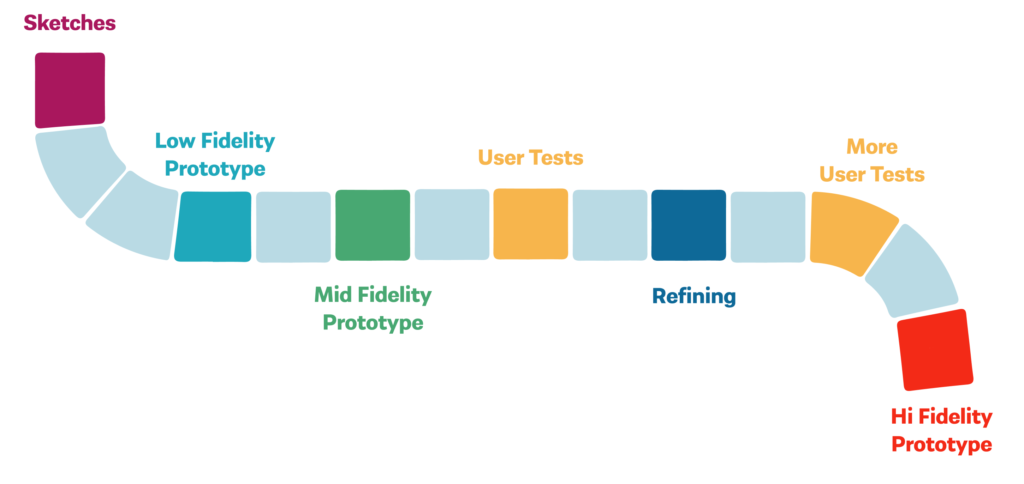
Sketches

Prototype
Product Features
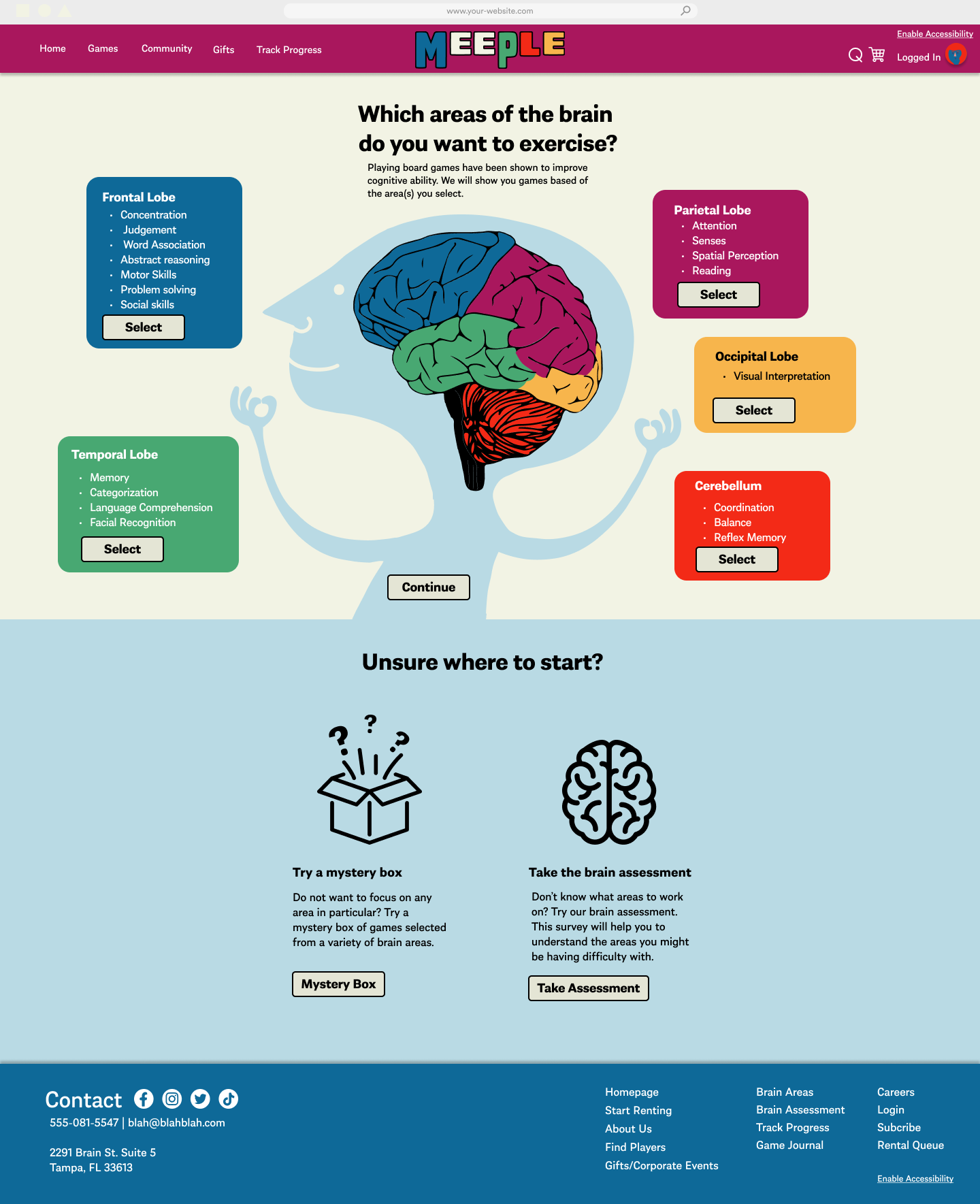
- Filtering by brain function and player count– older adults know the areas they want to improve upon but might not know the games available
- Finding other players– many people struggle to find people to play with
- Ability to track progress– users want to see that board games actually help with cognitive ability
- Game suggestions– many users do not know what games they want without researching the games first
- Chat bot help– some of the users in the mindset are not traditionally tech savvy
Low to Mid Fidelity Prototype


Initial Design Concepts
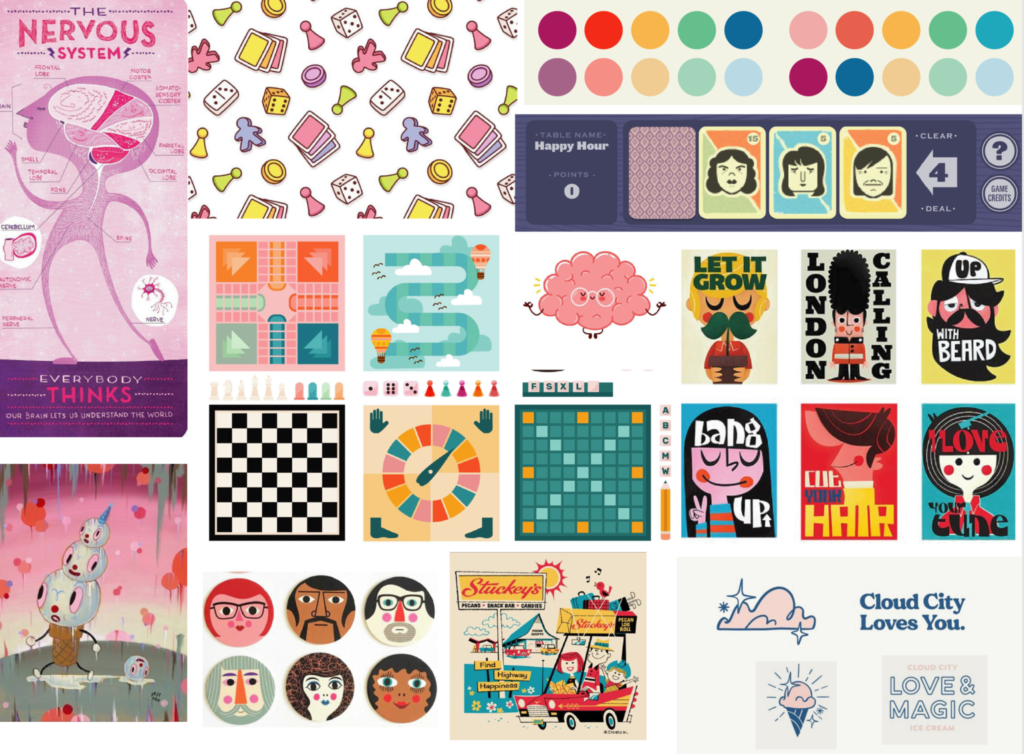
I wanted to create a product that incorporates board game elements and is:
- Happy
- Educational but not too stiff
- Retro
- Fun
Mood Board
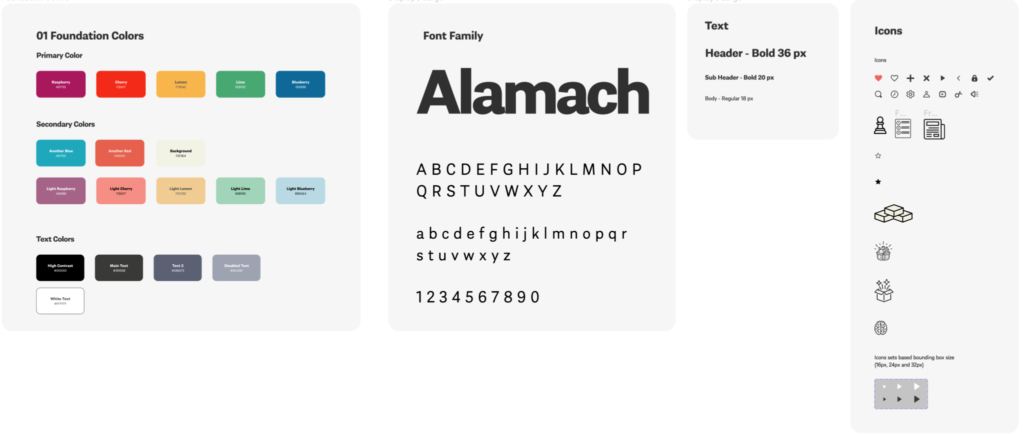
Design System
Test
I tested several remaining assumptions:
- Users know their problem areas and will chose games by their weaknesses
- People would use a “find other players” and a “Track progress” feature.
- There is a price point and length of rental that can be found.
- Users will be able to navigate the website easily and understand the concept
Refinement from Test Results
Through AB testing and scenarios, I found that everyone was able to get through the scenarios I created. Testers liked the “find a friend” feature but were concerned with speaking with individuals and preferred groups. Though people mainly knew their weakness areas, a lot seemed excited to take a brain assessment. People seemed comfortable with the price. I made the following changes from these tests:
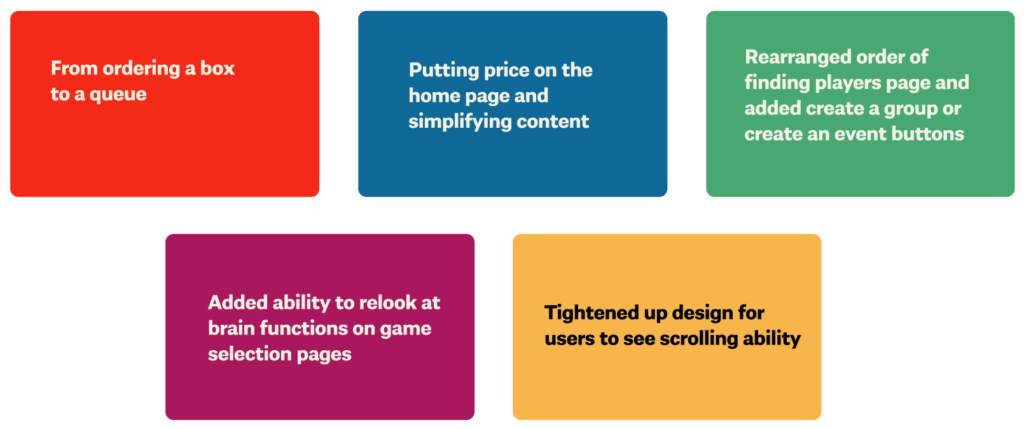
Major Ordering Flow Pivot
Even though testers were able to get through ordering a subscription of board games easily, people had different opinions on how often the box should be sent. I ended up testing two different flows. The first flow had the user order several games three boxes at a time. The other flow just had the user add games to a queue. Users seemed to like the queue better and were used to it with previous experience using sites like Netflix.
Deliver
Final Prototype
Scenarios Tested:
- Add a game to the queue
- Find the game journal area
- Find a player to play games with
Here is the final prototype via Figma. For the best experience, please view this on a desktop:
Not Just another E-commerce Site


Next Steps
If I were to make this into a real product, there are many more steps that would need to happen, here are a few:

Lessons Learned

I had so much fun creating this project! Throughout the 16 weeks I learned so much that will help me on future projects, here are a few:
- Spend more time testing users on variations
- Try more tools like journey mapping and sacrificial concepts
- Be more open to pivots from the initial product idea
- Focus on getting better at file organizing and deliverables